


 Reviews
 Login
Login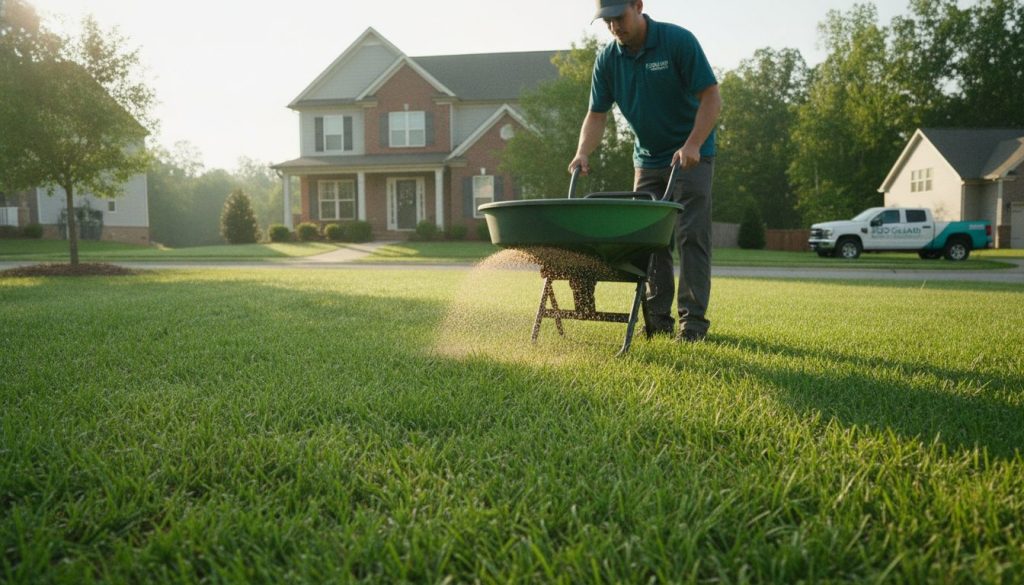
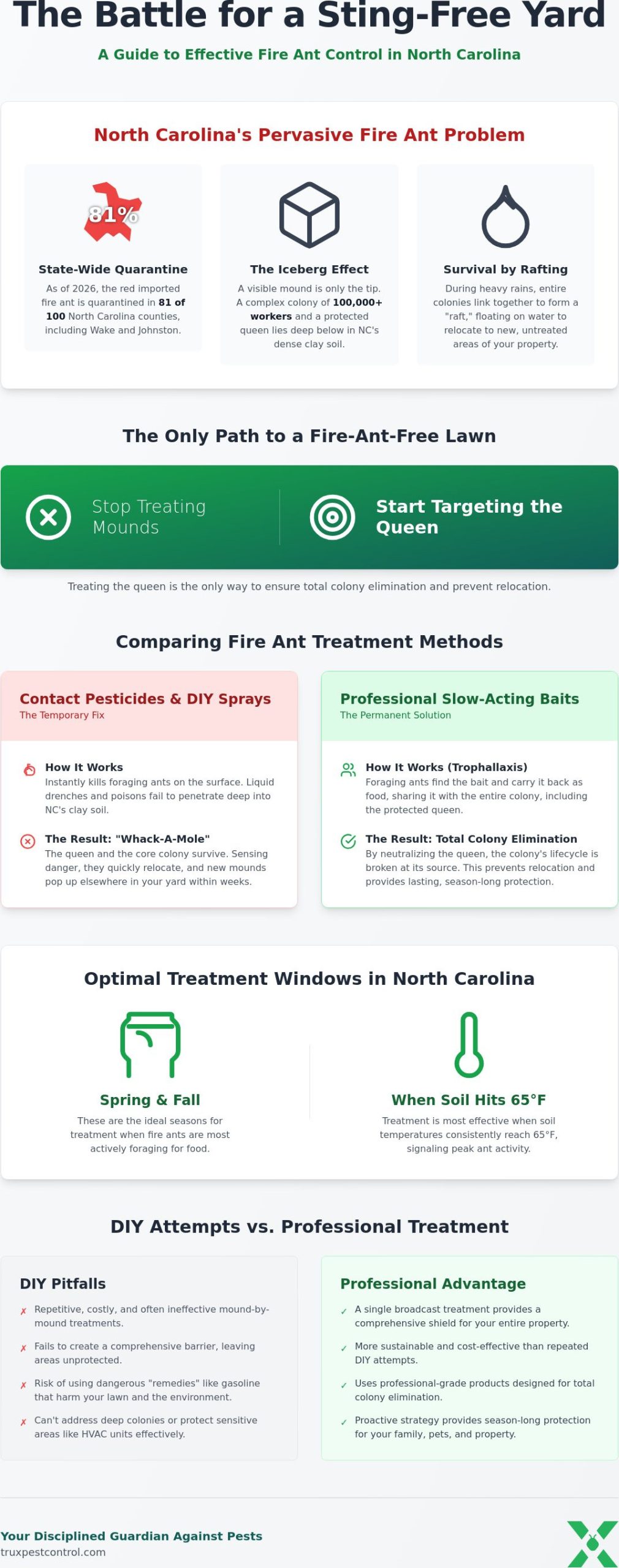
Dumping a bag of store-bought poison directly onto a visible mound is often the most effective way to ensure fire ants simply move to another part of your lawn. It’s a frustrating cycle that many North Carolina families know all too well. You treat a pile near the driveway, only to find two new ones popping up by the HVAC unit or the backyard play area a week later. With the red imported fire ant now quarantined in 81 of our 100 counties as of 2026, these resilient pests are more than just a nuisance; they’re a persistent threat to your home’s comfort and safety.
Achieving a truly sting-free yard requires a shift in strategy. This guide explains why specialized fire ant treatment NC focuses on colony elimination rather than just mound suppression. You’ll discover how a methodical, two-step approach targets the queen to stop the lifecycle at its source. We’ll help you understand the difference between temporary DIY fixes and the professional techniques that provide season-long protection for your pets, your property, and your peace of mind.
Key Takeaways
- Targeting the queen is the only way to ensure total colony elimination, preventing the ants from simply relocating to a new part of your lawn.
- Optimal fire ant treatment NC occurs during the Spring and Fall windows when soil temperatures reach 65°F and foraging activity is at its peak.
- Utilizing slow-acting baits is more effective than contact pesticides because it leverages the ants’ natural behavior to deliver the treatment to the entire colony.
- North Carolina’s specific climate challenges require a proactive strategy to protect sensitive areas like HVAC units and electrical systems from fire ant damage.
- Professional broadcast treatments provide a comprehensive shield for your entire property, offering a more sustainable and cost-effective solution than repetitive DIY attempts.
Table of Contents
-
The Fire Ant Challenge in North Carolina: Why They Are Harder to Kill Here
-
DIY vs. Professional Fire Ant Treatment: Making the Right Choice
-
TruX Fire Ant Solutions: Your Disciplined Guardian in Johnston and Wake County
The Fire Ant Challenge in North Carolina: Why They Are Harder to Kill Here
North Carolina provides an ideal environment for the Red imported fire ant (Solenopsis invicta) to thrive and expand. Unlike our native ant species, which typically avoid human interaction, these invasive pests are notoriously aggressive. They don’t just bite; they swarm and sting repeatedly to defend their territory. Our state’s high humidity and relatively mild winters mean these colonies rarely go dormant. While you might see fewer mounds during a cold snap, the colony hasn’t disappeared. They’ve simply retreated deeper into the earth to wait for the next warm day. This year-round resilience is why reactive fire ant treatment NC often fails to provide lasting relief.
A single visible mound is truly just the tip of the iceberg. Below that pile of loose soil lies a complex, vertical network of tunnels that can house upwards of 100,000 worker ants and a highly protected queen. These colonies are structured for survival. If the mound is disturbed or a surface-level poison is applied, the workers can quickly relocate the queen to a deeper chamber or a secondary satellite mound. This biological defense mechanism is the reason many homeowners feel like they’re playing a never-ending game of "whack-a-mole" with their lawn care.
The Impact of NC Clay Soil on Colony Depth
Our local clay soil presents a unique hurdle for effective pest management. This dense, heavy earth allows fire ants to construct incredibly stable and deep galleries that are nearly impossible for standard liquid sprays to penetrate. Surface treatments usually only kill the ants near the top, leaving the heart of the colony untouched in the deep clay tunnels. Additionally, heavy North Carolina spring rains often trigger a fascinating but frustrating survival tactic called "rafting." During heavy downpours or localized flooding, the entire colony links bodies to float on the water’s surface, eventually depositing themselves in new, untreated areas of your property or even against your home’s foundation.
NC Fire Ant Quarantine and Your Property
As of early 2026, the North Carolina Department of Agriculture and Consumer Services has expanded the imported fire ant quarantine to include 81 counties, including Wake and Johnston. This regulation is a serious effort to slow the spread of these pests. It requires residents and businesses to be extremely careful when moving items like sod, soil, or nursery stock, which can easily hide a developing colony. By investing in a professional fire ant treatment NC plan, you aren’t just protecting your family from painful stings. You’re also ensuring your property remains compliant with state environmental standards and helping prevent the further spread of this invasive species into non-infested areas of our state.
Comparing Treatment Methods: Baits vs. Contact Pesticides
Achieving a long-term fire ant treatment NC result requires a shift in focus from the visible mound to the invisible queen. Most standard contact pesticides provide a "quick knockdown," which kills the worker ants on the surface almost instantly. While this offers immediate gratification, it rarely solves the underlying problem. If the queen survives, she can continue producing thousands of new workers every week, ensuring the colony’s survival. To break this cycle, we must utilize products that the ants themselves carry into the deepest parts of their network.
A more sophisticated strategy involves the use of broadcast granules and slow-acting baits. These methods are designed to leverage the ants’ natural foraging behavior. While it takes longer to see results than a liquid drench, the outcome is far more durable and comprehensive. The NC State University Extension highlights several fire ant control methods for North Carolina, emphasizing that a combination of baiting and targeted treatment is often the most reliable path to success. Homeowners should avoid dangerous DIY "remedies" like pouring boiling water or gasoline on mounds; these are ineffective at reaching deep galleries and can cause significant damage to your lawn and the local ecosystem.
The Science of Professional Baits
Professional-grade baits work through a biological process called trophallaxis. Foraging ants find the bait, consume it, and carry it back to the nest to share with the rest of the colony, including the queen. This ensures the entire population is neutralized from the inside out. Unlike many store-bought options that can quickly lose their potency, professional baits use high-quality attractants that remain enticing to foragers even in the humid North Carolina air. Maintaining bait freshness is critical. If the product becomes rancid or damp due to improper storage or application timing, the ants will simply ignore it, leaving your property unprotected.
Direct Mound Treatment: When It’s Necessary
There are times when waiting for bait to work isn’t an option. We prioritize direct mound treatments in high-risk areas where immediate safety is a primary concern:
-
Near children’s play sets or sandboxes.
-
Around dog runs and designated pet areas.
-
Adjacent to expensive HVAC units or electrical boxes.
In these cases, we use a targeted knockdown to clear the immediate threat and prevent painful stings. However, this must always be paired with a broader baiting program to prevent the colony from simply relocating. A critical rule is never to disturb the mound before treatment. If you kick or poke a mound, the ants enter defense mode and may move the queen deeper into the earth before the product can reach her. If you’re seeing mounds near your foundation or equipment, our team at TruX Pest Control can help you implement a professional program that protects your home’s value and your family’s comfort.
The Timing Factor: When to Treat for Fire Ants in NC
Successful fire ant control is less about the volume of product used and more about the precision of the application. In North Carolina, we recognize two primary windows for highly effective fire ant treatment NC: the spring surge from March through May and the fall preparation period from September through October. During these months, the colony is actively expanding and foraging for food to support the queen and the developing brood. If you apply treatment outside of these specific windows, you’re often fighting against the ants’ natural biological cycle, which leads to wasted resources and continued lawn damage.
The most critical metric we track is soil temperature. Foraging activity typically begins once the soil temperature reaches a consistent 65°F. If the ground is too cold, the ants remain deep in their galleries. Conversely, the intense heat of a July afternoon in Raleigh or Clayton often drives ants deep underground to stay cool. Applying bait during the hottest part of a summer day is usually ineffective because the ants aren’t on the surface to collect it; plus, the sun’s UV rays can quickly degrade the bait’s attractants. You can perform a simple "Hot Dog Test" to see if your local colony is active. Place a small slice of a hot dog near a mound; if ants don’t swarm it within 30 minutes, it’s not the right time to treat.
For a deeper dive into these biological triggers, the NC State Extension guide to fire ants provides excellent data on local foraging patterns. Understanding these nuances is what separates a professional application from a standard DIY attempt.
Weather Considerations: Rain and Dew
Water is the enemy of effective baiting. If bait is applied within six hours of a rainstorm or while heavy morning dew is still on the grass, the product will likely dissolve or become unappealing to the ants. Moisture renders the treatment useless. At TruX, we closely monitor local weather patterns in Wake and Johnston counties to schedule our visits during dry spells. We generally find that the early evening is the best time for application. This timing avoids the mid-day sun and aligns with the peak foraging hours for workers, ensuring the bait is carried back to the queen as quickly as possible.
Winter Dormancy vs. Activity
It’s a common misconception that fire ants die off during a cold North Carolina winter. They don’t. Instead, they move deep into the soil, sometimes several feet down, to escape the frost line. While you won’t see mounds during a freeze, the colony is simply waiting for the first warm day to return to the surface. Winter is the ideal time for "exclusion" work, such as sealing gaps around your home’s foundation and preparing your strategy for the spring surge. Fire ants will only begin active foraging again once the soil temperature maintains a steady threshold of at least 65 degrees.
DIY vs. Professional Fire Ant Treatment: Making the Right Choice
Choosing between a trip to the local hardware store and calling an expert often comes down to a perceived cost difference. However, the "mound-by-mound" DIY approach usually results in a cycle of repeated purchases and ongoing frustration. While a bag of granules might seem cheaper upfront, it doesn’t account for the hidden costs of failed applications, damaged turf, or the physical pain of stings on your kids and pets. A professional fire ant treatment NC program provides what we call a "Total Yard Shield." Instead of chasing individual piles of dirt, we treat the entire landscape to eliminate existing colonies and prevent new ones from establishing themselves.
The technical superiority of professional service lies in the equipment and the precision of the application. We utilize calibrated broadcast spreaders designed for even distribution, ensuring that every square foot of your property is covered. This is critical because foraging ants can travel long distances from the visible mound. Hand-tossing store-bought bait often leaves gaps where colonies can survive and thrive. By using professional-grade products and specialized equipment, we create a consistent barrier that is both more effective and safer for your family than the haphazard application of high-concentration DIY chemicals.
The "Satellite Mound" Trap
Aggressive DIY chemicals often act as a warning bell for the colony. When a homeowner pours a fast-acting poison on a mound, the worker ants perceive the threat immediately. In a desperate bid for survival, the colony may "bud" or split. This means the workers carry larvae and queens to several different locations, creating multiple new satellite mounds overnight. This is the "Ant Whack-a-Mole" phenomenon many North Carolina homeowners face. Professional baiting avoids this by using slow-acting agents that the ants don’t recognize as a threat until it’s too late, ensuring the entire network is neutralized without triggering a split.
Protecting Your HVAC and Electrical Systems
Fire ants are uniquely attracted to electrical currents, a biological behavior known as electrotaxis. This attraction often leads them to swarm inside air conditioning compressors, outdoor outlets, and circuit breakers. Once they enter these units, they can chew through wire insulation or create massive bridges of dead ant bodies that short-circuit the entire system. This often results in thousands of dollars in repair bills for your HVAC or electrical components. At TruX, we establish a methodical, protective barrier around these critical home systems. If you want to stop the cycle of DIY failure and protect your property value, contact the experts at TruX Pest Control to secure a comprehensive fire ant treatment NC plan today.
TruX Fire Ant Solutions: Your Disciplined Guardian in Johnston and Wake County
At TruX Pest Control, we approach fire ant treatment NC with the precision and discipline of a seasoned guardian. We understand that your yard is more than just a patch of grass; it’s the place where your children play and your pets roam. Our 20 years of local experience across Wake and Johnston counties gives us a distinct advantage. We know the specific composition of the soil in Clayton, Raleigh, and Smithfield. This local knowledge allows us to predict how fire ant colonies will behave in our dense clay, ensuring our treatments reach the heart of the colony rather than just the surface.
Our specialized fire ant mitigation is designed to work seamlessly with our General Pest Control and Mosquito Control plans. We believe in a holistic approach to property protection. By integrating these services, we create a comprehensive shield that addresses multiple threats simultaneously. Johnston County homeowners dealing with both fire ants and biting insects can also benefit from our mosquito prevention Johnston County strategies to fully reclaim their outdoor living spaces. This methodical strategy doesn’t just kill pests; it restores the comfort and security of your outdoor living spaces. You shouldn’t have to scan the grass for mounds every time you step outside. Our goal is to provide you with a permanent state of relief and long-term stability.
Our Comprehensive Property Inspection
Every effective treatment plan begins with a thorough, detail-oriented inspection. We don’t just look for the obvious mounds that have already breached the surface. Our experts are trained to identify the subtle signs of hidden colonies and satellite nests before they become a major hazard. We analyze your property’s specific layout, moisture levels, and proximity to structures. This data allows us to build a customized plan that uses eco-friendly, family-safe application methods. We take our responsibility to your family and the local ecosystem seriously, choosing products that offer maximum impact on the colony with a minimal environmental footprint.
Reclaim Your Backyard Today
The path to a sting-free summer is simple and transparent. It starts with a professional inspection to map out the infestation. Next, we implement our targeted treatment strategy, using the high-quality baits and broadcast methods discussed earlier. Finally, we establish a consistent maintenance schedule to ensure those colonies don’t return. We take pride in being a community-focused business that treats every customer like a neighbor. You can trust our steady, logical process to deliver the results you deserve. Don’t wait for the next painful sting to take action. Schedule your professional fire ant inspection with TruX Pest Control and start the journey toward a safer, more comfortable home today.
Secure Your Lawn and Protect Your Family
Eliminating fire ants in North Carolina isn’t a one-time event; it’s a strategic commitment to your property’s safety. These resilient colonies use our dense clay soil and humid climate to survive year-round, often outlasting superficial hardware store fixes. By focusing on the queen through methodical baiting rather than just treating visible mounds, you stop the cycle of colony splitting and relocation. Choosing a professional fire ant treatment NC plan ensures that every square foot of your lawn is protected by high-quality, calibrated applications that DIY methods simply can’t match.
TruX Pest Control brings over 20 years of local expertise to your doorstep. As a family-owned business serving Clayton and Raleigh, we prioritize eco-friendly and pet-conscious techniques that restore your peace of mind. We don’t just kill ants; we provide a disciplined shield for your home, HVAC units, and electrical systems. Beyond fire ants, protecting your outdoor spaces from all seasonal pests is essential — explore our expert mosquito prevention tips for Johnston County homeowners to keep your yard comfortable all summer long. Reclaim your yard from fire ants-request a TruX inspection today. You deserve a backyard where your family can play without fear and your pets can roam in total comfort.
Frequently Asked Questions
Is fire ant treatment in NC safe for my dogs and cats?
Professional fire ant treatments are designed with the safety of your family and pets as a top priority. Once the applied product has dried or settled according to the specific label instructions, it’s safe for dogs and cats to return to the yard. At TruX, we utilize pet-conscious application methods that target the colony while minimizing exposure to your four-legged family members, ensuring your home remains a secure environment.
How long does it take for fire ant bait to work?
You can typically expect to see a total colony collapse within one to four weeks after a professional bait application. Unlike contact sprays that provide an immediate but temporary kill of surface workers, baits must be systematically shared throughout the nest. This methodical process takes a few days to reach the queen, but it’s the only way to ensure the entire mound is neutralized permanently.
Can I get rid of fire ants permanently?
Permanent eradication is impossible because fire ants are a highly mobile invasive species that has spread to 81 North Carolina counties. New queens from neighboring properties can fly into your yard and establish new colonies at any time. However, a consistent fire ant treatment NC program creates a protective shield that eliminates existing mounds and prevents new ones from establishing a foothold on your property.
Why do fire ants come back after a heavy rain in North Carolina?
Fire ants don’t actually return after a storm; they simply become more visible to the naked eye. Heavy rains flood their deep underground galleries, forcing the colony to move higher into the soil or build prominent mounds to stay dry. This is why you often see a sudden surge of activity near sidewalks and driveways immediately following a typical North Carolina summer downpour.
Do fire ants really damage air conditioning units?
Fire ants frequently cause expensive damage to HVAC systems and outdoor electrical components. They are biologically attracted to the electromagnetic fields produced by live wires, a behavior known as electrotaxis. Once inside a unit, they can chew through insulation or crowd into contactors, causing the system to short circuit. Professional treatment includes establishing a defensive perimeter around these critical units to prevent thousands of dollars in repairs.
What is the best time of year to treat for fire ants in Raleigh?
The optimal windows for fire ant treatment NC in the Raleigh area are during the spring and fall months. We specifically target March through May and September through October when soil temperatures are between 70°F and 85°F. Treating during these biological sweet spots ensures that the ants are actively foraging and will quickly deliver the bait to the heart of the colony.
Are fire ant stings dangerous for everyone?
While fire ant stings are painful and cause itchy, fluid-filled welts for most people, they can be life-threatening for individuals with specific venom allergies. A single colony can deliver hundreds of stings in seconds if a child or pet accidentally disturbs a mound. For families with sensitive members, professional colony elimination is a critical proactive step to restore safety and comfort to your backyard.
Should I pour gasoline or boiling water on fire ant mounds?
You should never use gasoline or boiling water as a DIY remedy. Gasoline is a severe environmental pollutant that kills your turf and poisons the soil, while boiling water rarely reaches the queen in our dense clay galleries. These dangerous attempts often just "scare" the colony, causing them to split into multiple new satellite mounds nearby, which only makes the infestation more difficult to manage.
