


 Reviews
 Login
Login
What if those persistent cobwebs in your corners aren’t just a cleaning oversight, but a clear signal that your home’s ecosystem is out of balance? For many homeowners, learning how to get rid of spiders in house NC environments feels like an endless cycle of sweeping and spraying. You aren’t alone if you feel a jolt of anxiety when a Wolf spider darts across the rug or if you’re constantly checking the kids’ play area for Black Widows. It’s unsettling to feel like an intruder in your own living room, especially when standard store-bought solutions fail to stand up to the unique pest pressures of Wake and Johnston Counties.
We believe your home should be a sanctuary, not a habitat for unwanted arachnids. This guide provides the professional local insights you need to identify common North Carolina species and eliminate them for good. We’ll show you how to harden your home’s defenses through exclusion, manage the moisture that attracts prey, and implement a proactive strategy for a truly spider-free environment. By the end of this article, you’ll have the peace of mind that comes with a methodical, expert-backed approach to home protection and family safety.
Key Takeaways
- Distinguish between harmless local spiders and medically significant species to prioritize your family’s safety and peace of mind.
- Learn why a sudden surge in spider activity often signals a hidden insect problem and how to eliminate their primary food source.
- Identify the specific structural vulnerabilities and moisture issues common in North Carolina homes that invite persistent infestations.
- Master the essential exclusion and sanitation steps for how to get rid of spiders in house NC to keep pests out for good.
- Understand how a professional Integrated Pest Management (IPM) approach uses eco-friendly methods to create a lasting protective shield for your home.
Identifying Common Spiders in North Carolina Homes
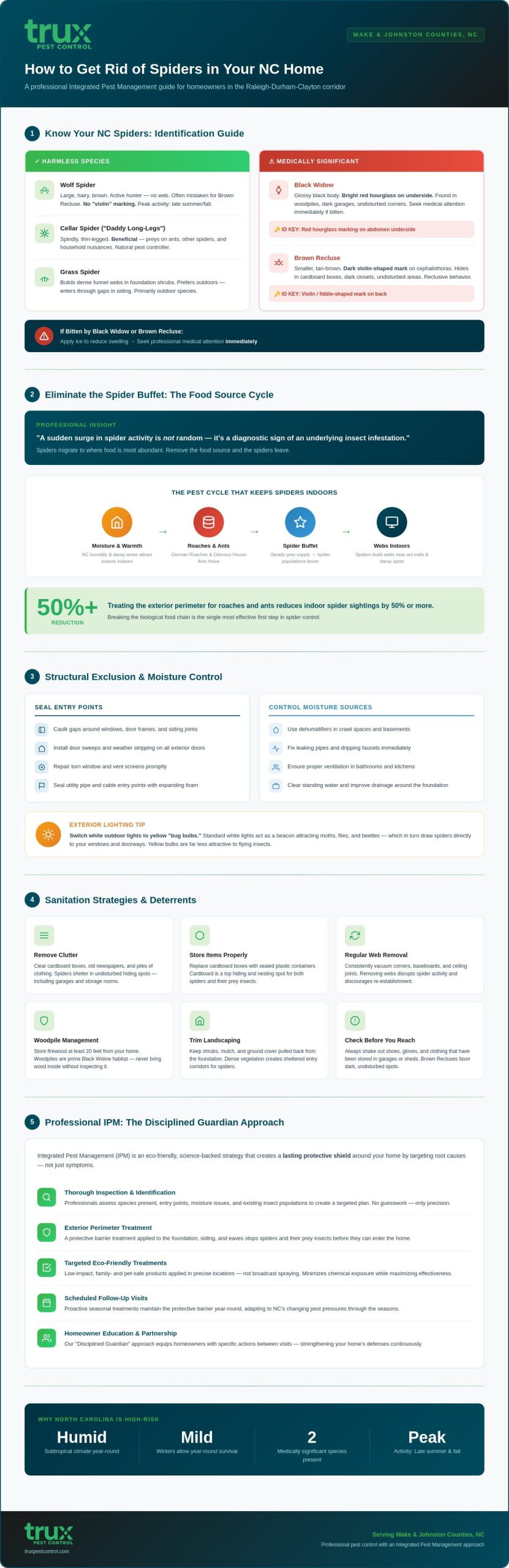
North Carolina’s humid subtropical climate serves as a productive habitat for a wide variety of arachnids. Mild winters and high humidity levels in the Raleigh-Durham-Clayton corridor provide an environment where many species can thrive year-round. We approach identification from a “Disciplined Guardian” perspective, believing that accurate knowledge is the first layer of defense for your family. When you understand the specific behaviors and habitats of these pests, you can implement more effective exclusion strategies. Learning the difference between a harmless wanderer and a potential threat is the foundation for anyone researching how to get rid of spiders in house NC environments. In Wake County, the Black Widow and Brown Recluse represent the primary safety concerns for homeowners due to their medically significant venom.
Harmless but Startling: Wolf Spiders and Cellar Spiders
Wolf spiders are a frequent source of concern for Raleigh homeowners, especially during their peak activity periods in the late summer and fall. These large, hairy hunters do not spin traditional webs to catch prey; instead, they actively stalk and chase down insects. Because of their impressive size and brownish coloring, they are often mistaken for the more dangerous Brown Recluse. However, Wolf spiders possess distinct common spider characteristics such as a unique eye arrangement and a lack of the “violin” marking. You might also notice dense “funnel webs” in your foundation shrubs. These usually belong to grass spiders, which prefer to stay outdoors but occasionally wander inside through gaps in the siding. Meanwhile, the spindly Cellar spider, commonly known as the “Daddy Long-Legs,” acts as a natural pest controller. They are known to prey on other household nuisances, including ants and smaller spider species, making them a relatively helpful, albeit uninvited, house guest.
Species of Concern: Black Widows and Brown Recluses
True home protection requires a sharp eye for the two species that pose a legitimate health risk. The Black Widow is easily identified by its glossy black body and the bright red hourglass marking on its underside. In contrast, the Brown Recluse is smaller and features a dark, violin-shaped mark on its cephalothorax. These spiders are reclusive by nature and prefer undisturbed, dark environments. You’ll typically find them in outdoor woodpiles, dark corners of the garage, or inside cardboard boxes that haven’t been moved in months. If you suspect a bite from either of these species, seek professional medical attention immediately. We recommend applying ice to the affected area to help manage swelling while you are in transit. Identifying these risks early allows us to provide a methodical, professional solution that restores comfort and security to your living space.
Eliminating the Spider Buffet: Managing Food Sources
A sudden increase in spider activity inside your home is rarely an isolated event. As natural predators, spiders migrate to areas where their food supply is most abundant. If you are seeing more webs in your corners, it’s often a diagnostic sign of an underlying insect infestation that requires your attention. We view pest management as the creation of a protective shield; by eliminating the primary food source, you naturally discourage spiders from taking up residence. This holistic approach is the most effective way to address how to get rid of spiders in house NC residents encounter throughout the changing seasons. When you remove the incentive for them to stay, you’ve already won half the battle.
The Link Between Roaches, Ants, and Spiders
In our region, German Roaches and Odorous House Ants are the most common protein sources for domestic spiders. You’ll often notice that spider webs are strategically positioned near active ant trails or in damp areas where roaches congregate. These pests provide a steady diet that allows spider populations to grow rapidly. We’ve found that treating the exterior perimeter for these crawling insects can reduce indoor spider sightings by 50% or more. Our General Pest Control in Raleigh NC service focuses on breaking this biological cycle by removing the “buffet” that keeps spiders coming back. When the prey disappears, the predators are forced to look elsewhere for survival.
Managing Exterior Lighting and Landscaping
Your home’s exterior environment plays a significant role in attracting spider prey. Standard white outdoor lights act as a beacon for moths, flies, and beetles, which in turn draw spiders directly to your windows and doorways. We recommend switching to yellow “bug bulbs” to minimize this night-time attraction. Additionally, your landscaping can serve as a direct bridge into your living space. We advise keeping all shrubs and branches at least 12 inches away from your Clayton home to prevent spiders from easily crossing over to your siding. Thick mulch beds near the foundation are another common culprit, as they provide the moisture and shelter that many insects prefer. Implementing these spider elimination strategies ensures your property is less inviting to the entire pest hierarchy. If you’re ready to establish a more permanent barrier against these intruders, you can request a professional assessment to secure your home’s perimeter today.
Structural Exclusion and Moisture Control in NC
While managing food sources is vital, the most sustainable method for long-term protection is structural exclusion. This proactive strategy involves identifying and sealing the physical gaps that allow pests to enter in the first place. For those mastering how to get rid of spiders in house NC residents must consider the specific architectural vulnerabilities of our region. A gap as narrow as 1/16th of an inch, roughly the thickness of a penny, provides sufficient clearance for most common house spiders to penetrate your home’s exterior envelope. By hardening these entry points, we create a permanent deterrent that reduces the need for reactive treatments and preserves the integrity of your living space.
The Crawl Space Connection: Vapor Barriers and Spiders
In the humid Johnston County climate, crawl spaces often become the primary staging ground for infestations. High moisture levels in these dark, undisturbed areas attract silverfish and crickets, which are among the favorite prey for larger spider species. We utilize specialized crawl space moisture control services to address this root cause directly. Installing a professional Crawl Space Vapor Barrier transforms a damp breeding ground into a dry, inhospitable environment for pests. This follows the core principles of Integrated Pest Management (IPM), focusing on environmental modification rather than just chemical application. Keeping your crawl space dry is one of the most effective ways to lower the overall pest pressure on your entire home.
Sealing the Foundation and Utility Lines
Our brick-and-siding homes in North Carolina present unique challenges that require a detail-oriented approach. Weep holes in brick siding are essential for ventilation but often act as open doorways for wandering spiders. You can protect these openings by inserting specialized covers or stainless steel mesh that allows airflow while blocking pests. Additionally, inspect the areas where HVAC and plumbing lines enter your foundation. We recommend using silicone caulk or copper mesh to seal these penetrations, as standard expanding foam can often be chewed through or degrade over time. In suburban Raleigh homes, the garage door seal is frequently the #1 entry point for Wolf spiders seeking shelter. Replacing worn weather-stripping and ensuring a tight seal against the floor is a critical step in maintaining your home’s protective shield and ensuring long-term stability.
Sanitation Strategies and Effective Deterrents
Establishing a protective shield around your family requires more than just sealing the exterior. Internal sanitation is a critical behavioral component of how to get rid of spiders in house NC residents can implement immediately. We advocate for a “Clean Home” protocol that focuses on removing the specific environmental conditions spiders need to thrive. By reducing clutter and maintaining a disciplined cleaning schedule, you eliminate the dark, undisturbed hiding spots where species like the Black Widow or Yellow Sac spider prefer to build their nests. This methodical approach ensures that even if a spider bypasses your structural defenses, it finds no suitable place to settle or reproduce.
De-webbing and Vacuuming Techniques
Regular de-webbing is one of the most effective ways to disrupt the reproductive cycle of house spiders. We recommend using a vacuum with a long attachment to reach high corners, areas behind heavy furniture, and the dark spaces under kitchen appliances. It is vital to vacuum the spider and the egg sac simultaneously. A single egg sac can contain hundreds of spiderlings; leaving it behind guarantees a future generation of pests inside your living space. Once your cleaning session is complete, always dispose of the vacuum bag or empty the canister into a sealed trash bin outside your home. This simple step prevents captured spiders from crawling back out and re-infesting your interior rooms.
Safe Indoor Deterrents
Homeowners often seek natural alternatives, but it’s essential to separate scientific reality from internet myths. While peppermint oil and chestnuts are frequently cited as natural repellents, research indicates they offer negligible long-term protection against established spider populations. These substances lack the residual strength of professional barriers and often dissipate before they can provide any real benefit. Instead, we suggest utilizing sticky traps as a highly effective diagnostic tool. Placing these traps along baseboards and in dark corners allows you to monitor pest activity and identify exactly where spiders are entering or congregating. Creating a “no-clutter zone” by keeping items at least six inches away from interior walls also removes the physical pathways spiders use to navigate your home undetected.
While organizing your garage to prevent infestations, it’s also important to consider the interior of your vehicles. Utilizing high-quality, custom-fit automotive mats and insulation from Tru-Fit Carpets by Vision Auto can help keep your car’s cabin clean and discourage spiders from finding a sheltered nesting site in your vehicle’s flooring.
In Johnston County garages and attics, safe storage practices are paramount. We recommend replacing old cardboard boxes with airtight plastic bins to prevent spiders from nesting in seasonal decorations or clothing. Cardboard provides organic material and easy entry points that spiders find irresistible. If you have followed these steps and continue to see persistent activity, it may be time to schedule a professional spider control treatment to restore total comfort and security to your environment. Our team provides the seasoned expertise needed to handle complex infestations with precision and care.
Professional Spider Control: The TruX Disciplined Guardian Approach
While domestic sanitation and structural exclusion form your home’s first line of defense, established infestations often require a higher level of tactical intervention. Professional intervention becomes a necessity when dealing with medically significant species like Black Widows, which often nest in the complex, hard-to-reach areas of your foundation or crawl space. We provide a sophisticated alternative to standard exterminating services by utilizing Integrated Pest Management (IPM). This methodical approach allows us to target the root cause of your pest issues while prioritizing the health and safety of your household. For families researching how to get rid of spiders in house NC residents can trust our 20 plus years of local experience to deliver results that are both effective and environmentally responsible.
We view ourselves as your partners in home protection, not just a service provider. Our team understands the specific environmental pressures of the Raleigh-Durham-Clayton corridor, from the high humidity that drives prey insects indoors to the seasonal migration patterns of local arachnids. We focus on long-term stability rather than quick, superficial fixes. By choosing eco-friendly techniques, we provide Raleigh and Cary families with a protective shield that doesn’t rely on broad-spectrum, harsh chemicals. This ensures your children and pets can enjoy a comfortable environment without the worry of unmanaged pests or heavy residues.
Just as professional pest management requires specialized training, Raleigh residents can find expert education in other fields; if you are interested in the beauty and wellness industry, you can explore Esthetics Program at 5T Beauty Academy.
Our Methodical Treatment Process
We follow a transparent, three-step journey to ensure your home is fully secured. This disciplined process mirrors the thoroughness we bring to every property we protect:
- Step 1: Comprehensive Inspection. We conduct a deep-dive assessment of your foundation, crawl space, and interior perimeters to identify nesting sites and entry points.
- Step 2: Targeted Application. We apply eco-friendly barriers specifically where spiders travel and hide, disrupting their lifecycle without unnecessary environmental impact.
- Step 3: Ongoing Monitoring. We provide neighborly support and proactive adjustments to your protection plan as the North Carolina seasons change.
Reclaiming Your Home and Backyard
Total peace of mind extends beyond your four walls. Many of our neighbors find that the best way to secure their property is by combining spider control with professional Mosquito Control. This dual approach eliminates the flying insects that serve as the primary food source for orb-weavers and other web-building spiders, creating a comprehensive “no-fly zone” around your porch and patio. Every service we provide comes with the TruX guarantee of professional authority delivered with a personal, neighborly touch. We are committed to restoring the comfort and security you deserve. Restoring your comfort starts with a quick signup, allowing our experts to begin building your personalized home protection shield today.
Secure Your Home and Restore Your Peace of Mind
Achieving a spider-free home in North Carolina requires more than just reactive spraying. It demands a methodical strategy that addresses the root causes of infestations, from managing moisture in the crawl space to eliminating the insect prey that draws predators inside. By combining diligent internal sanitation with professional structural exclusion, you create a lasting protective shield for your family. Understanding the specific behaviors and seasonal patterns of local species ensures you’re prepared to handle everything from common Wolf spiders to the more concerning Black Widow.
If you’ve been searching for how to get rid of spiders in house NC settings with long-term results, we’re ready to partner with you. Our team brings 20 plus years of North Carolina expertise to every property, utilizing eco-friendly and family-safe techniques that prioritize your comfort. We provide comprehensive crawl space and foundation protection to harden your home’s exterior against future invasions. Secure Your Home with Expert Spider Control Today and take the first step toward a safer, more serene living environment. You deserve the relief and security that comes with a professionally protected home.
Frequently Asked Questions
How do I know if the spider in my North Carolina home is dangerous?
Identification focuses on specific markings like the red hourglass or the violin shape. Most spiders in North Carolina are harmless, but the Black Widow and Brown Recluse are the two species that require caution. You can identify a Black Widow by its shiny black body and the distinct red hourglass on its abdomen. The Brown Recluse is smaller and light brown, featuring a dark violin-shaped mark on its back. If you don’t see these specific markers, the spider is likely a harmless house guest.
Do peppermint oil or vinegar actually keep spiders away?
These household items offer very limited deterrent effects and are not a substitute for professional control. Peppermint oil and vinegar don’t provide the long-term residual protection needed for an active infestation. While the strong scents might temporarily disrupt a spider’s senses, they evaporate quickly and don’t affect the spider’s reproductive cycle or food source. For a reliable solution on how to get rid of spiders in house NC residents should rely on structural exclusion and professional-grade barriers rather than temporary home remedies.
Why do I see more spiders in my house during the fall?
Seasonal migration occurs as temperatures drop and spiders seek warmth and food sources indoors. Fall is the peak season for spider sightings in the Raleigh-Durham area because many species reach maturity and begin searching for mates. As the weather cools, spiders and their insect prey naturally gravitate toward the warmth of your home’s interior. You’ll often see larger species like Wolf spiders wandering across floors during this time as they transition from the outdoors to find sheltered wintering spots.
Can spiders enter my home through the crawl space or vents?
Spiders frequently use crawl spaces and foundation vents as primary highways into your living areas. These spaces are often damp and dark, attracting the insects that spiders feed on. Once they establish a population under your home, they can easily migrate through floor penetrations, electrical gaps, and HVAC ductwork. Sealing these structural vulnerabilities is a critical step in maintaining a permanent protective shield for your home and preventing future intrusions.
Are the spider treatments used by TruX safe for my pets and children?
We utilize eco-friendly, family-safe techniques that prioritize the health of your household. We take the safety of your family and pets seriously by using products that are specifically formulated for residential environments. Our technicians apply these treatments with precision, focusing on cracks, crevices, and areas where children and pets don’t typically play. We follow a methodical process that balances professional authority with neighborly care, ensuring your home remains a secure sanctuary without the worry of harsh chemical residues.
How often should I have my home treated for spiders in Raleigh?
Quarterly treatments are generally recommended to maintain a consistent barrier against North Carolina’s seasonal pest pressures. Regular quarterly maintenance is the most effective way to ensure your home’s defenses never lapse. Each season brings different challenges, from the spring surge of ants to the fall migration of spiders. By having a professional assess your property every three months, we can identify new entry points and refresh the protective barriers that keep your environment comfortable and pest-free throughout the entire year.
What is the best way to prevent spiders from building webs on my porch?
Managing your exterior lighting and removing the insects that attract spiders is the most effective prevention method. Spiders build webs on porches because the lights attract a constant supply of moths and flies. We recommend switching to yellow bug bulbs and keeping your porch area clean of organic debris. Regularly sweeping down webs also disrupts the spider’s habit. Combining these sanitation efforts with our professional spider control helps ensure your outdoor living spaces remain inviting and clear of unsightly cobwebs.
Will a vapor barrier in my crawl space really help with spiders?
Yes, a vapor barrier is a highly effective structural solution that reduces the moisture spiders and their prey need to survive. Installing a professional vapor barrier transforms your crawl space from a damp habitat into a dry, inhospitable zone. Since spiders are drawn to the moisture and the insects it attracts, like crickets and silverfish, removing the humidity significantly lowers the pest pressure on your home. This specialized moisture control is a key component of our disciplined guardian approach to long-term pest management in Johnston County.
