


 Reviews
 Login
Login
You have spent the afternoon prepping the patio for a summer cookout, but the moment the sun begins to dip, the buzzing starts. Instead of relaxing with friends, you are rushing the kids and pets inside to avoid a fresh round of itchy welts. It is a familiar frustration for many of us living near the Neuse River floodplain or dealing with the heavy clay soil common in our area. Finding a reliable method for mosquito prevention Johnston County families can trust shouldn’t feel like a losing battle against nature.
We understand that your yard should be a sanctuary, not a source of stress over West Nile Virus or Eastern Equine Encephalitis. You deserve to enjoy your deck without a cloud of pests hovering over every gathering. This article shares professional strategies and eco-friendly tips to help you protect your home from seasonal surges. We will break down exactly why mosquitoes thrive on local properties and provide a clear, methodical plan to eliminate breeding sites from your crawl space to your garden. By the end, you will have the local expert knowledge needed to restore comfort and peace of mind to your outdoor spaces.
Key Takeaways
- Understand how Johnston County’s specific climate and heavy clay soil create the ideal conditions for seasonal mosquito surges.
- Identify hidden breeding sites across your property, keeping in mind that mosquitoes only need a bottle-cap-sized amount of water to multiply.
- Follow a methodical 7-step checklist for mosquito prevention Johnston County families can use to secure their yards and patios.
- Learn why professional barrier treatments and moisture control offer more reliable, long-term protection than standard store-bought foggers.
- Discover how local expert strategies can help you reclaim your outdoor space while prioritizing the safety of your children and pets.
Why Johnston County is a Haven for Mosquitoes
Johnston County offers a unique environment that mosquitoes find irresistible. Our region experiences a “perfect storm” of high humidity and mild winters, which allows local populations to thrive and rebound quickly each spring. Effective mosquito prevention Johnston County homeowners need requires a shift in perspective. Instead of viewing pest management as a series of reactive sprays, we see it as a proactive environmental management strategy. We focus on altering the conditions that allow these pests to flourish in the first place, acting as a disciplined guardian for your property.
The Neuse River basin plays a major role in our local pest pressure. This vast waterway and its surrounding floodplains provide endless breeding grounds, especially after heavy rains. In rural areas like Smithfield and Selma, agricultural runoff and older drainage patterns can lead to stagnant water that sits for days. These conditions create a constant influx of mosquitoes that can overwhelm a yard if a protective shield isn’t established. By understanding these comprehensive mosquito control strategies, you can begin to see your property as part of a larger ecosystem that requires careful, methodical management.
The Local Climate and the 2026 Mosquito Outlook
The typical North Carolina mosquito season is long, often stretching from March through late October. For 2026, early seasonal warming suggests that we may see emergence sooner than usual. This extended window of activity increases the timeframe of exposure to mosquito-borne illnesses. While human cases are rare, the presence of West Nile Virus and Eastern Equine Encephalitis (EEE) in our region makes professional prevention a matter of family safety. We monitor these trends closely to ensure our timing remains precise and effective for every neighbor we serve.
Geography and Landscape: From Clayton to Smithfield
Our local landscape varies significantly, from the urban growth in Clayton to the established groves in Smithfield. In Clayton, rapid new construction often disrupts natural soil drainage, leading to temporary pools of water that act as nurseries for larvae. Established yards throughout the county frequently feature dense foliage and thick layers of pine straw, which trap moisture and provide cool resting spots for adult mosquitoes during the heat of the day. Source reduction, which involves the methodical removal of these moisture-rich habitats, remains the primary defense against local infestations. Integrating a professional plan from TruX Pest Control can help you address these environmental factors before they become a nuisance.
Identifying Common Mosquito Breeding Sites Around Your Property
Securing your home begins with understanding the microscopic scale of the problem. A mosquito requires only a bottle-cap-sized amount of stagnant water to lay its eggs. In the humid North Carolina climate, these eggs can transform into biting adults in as little as seven to ten days. This rapid lifecycle means that a single overlooked container can produce hundreds of pests before you even notice a problem. Effective mosquito prevention Johnston County homeowners can implement starts with distinguishing between active breeding sites and resting sites. While active sites are where the lifecycle begins, resting sites are the shaded, cool areas like dense shrubs or pine straw where adults hide during the peak heat of the day.
Most neighbors focus on the visible areas of their yard, but we often find a hidden threat lurking beneath the structure itself. High humidity levels in our region frequently lead to condensation on pipes and damp soil within crawl spaces. This dark, protected environment provides a year-round haven for pests to thrive undisturbed. By addressing these structural moisture issues, you move beyond temporary fixes to long-term environmental management.
The Crawl Space Connection: A Hidden Breeding Ground
Because Johnston County sits in a humid subtropical zone, crawl spaces without proper moisture control often become “mosquito factories.” Damp soil under a house provides the perfect humidity levels for mosquitoes to survive even during dry spells. Installing a crawl space vapor barrier is a methodical way to manage this moisture and eliminate a primary breeding ground that most standard pest services overlook. This proactive step seals out ground moisture and creates a dry, inhospitable environment for larvae and other moisture-loving pests.
Standard Yard Culprits: Gutters, Toys, and Low Spots
In the yard, standard culprits often hide in plain sight. Clogged gutters act as elevated swamps, holding organic debris and stagnant water high above the ground where it is difficult to see. Corrugated downspout extensions are another common offender, as their ridges trap small pockets of water that never fully drain. We recommend a weekly “Tip and Toss” routine to clear out toys, tarps, and low spots after every rain event. Following CDC mosquito bite prevention tips alongside these property modifications provides a multi-layered shield for your family. If you find that these manual steps aren’t enough to keep the buzzing at bay, you can request a professional property assessment to identify and treat the more stubborn breeding zones.
DIY Prevention vs. Professional Mosquito Control
Many of our neighbors start the season with high hopes, lining their patios with citronella candles or “mosquito-repelling” plants like marigolds and lavender. While these additions are pleasant, they rarely provide the comprehensive protection needed to secure a yard. Store-bought foggers often offer only a temporary reprieve, as their effects dissipate quickly in the Johnston County humidity. True mosquito prevention Johnston County families can rely on requires a two-part strategy: homeowner sanitation and professional shielding. Think of your weekly efforts to clear standing water as the foundation, while professional intervention serves as the protective barrier that keeps the population from rebounding.
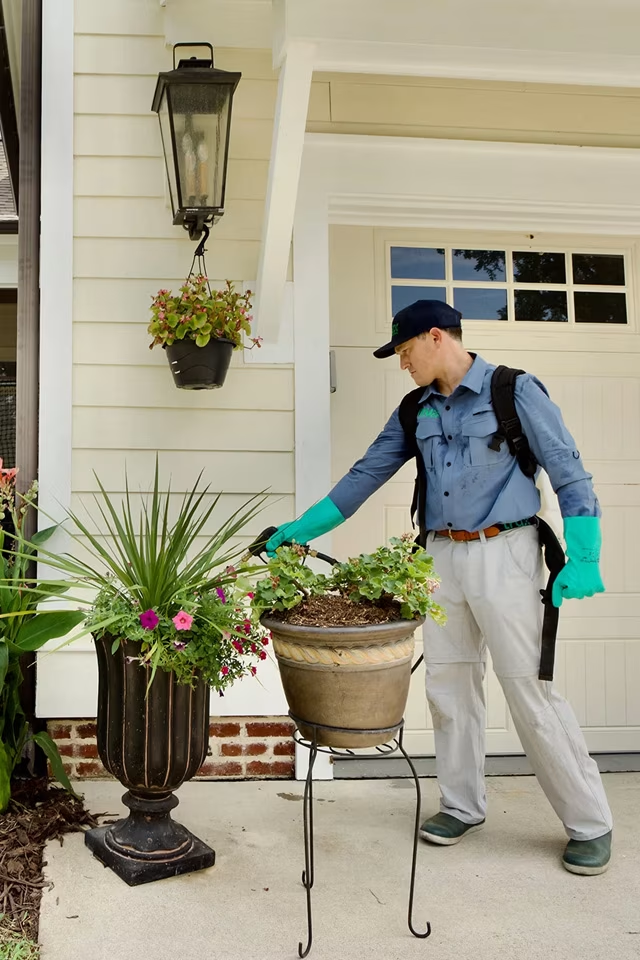
Professional barrier sprays are engineered differently than DIY cans. These treatments are designed to bond to the underside of leaves and dense foliage where mosquitoes rest, providing a lasting shield that survives light rain. For areas where water cannot be easily drained, such as certain drainage ditches or heavy clay low spots, we utilize professional larvicides. These targeted treatments stop the next generation of pests before they can take flight, offering a level of precision that standard retail products simply cannot match. This methodical approach ensures that we aren’t just treating the symptoms, but actively managing the environment.
When DIY Isn’t Enough: The Threshold for Professional Help
If you find yourself unable to step outside for five minutes without being swarmed, your property has likely reached a threshold where DIY methods will fail. A heavy infestation often indicates that breeding sites are located in hard-to-reach areas, such as the crawl spaces or high gutters we discussed previously. We utilize a science-based Integrated Pest Management (IPM) strategy to identify these specific triggers. This process is more cost-effective over the long term because it eliminates the need for repeated, ineffective store-bought applications. We act as your partner, providing the technical expertise needed to restore order to your backyard.
Eco-Friendly Options for Johnston County Families
We understand that the safety of your children, pets, and local pollinators is a top priority. That is why TruX offers specialized botanical and low-toxicity treatment options that provide effective mitigation without compromising your values. Our technicians are trained to avoid flowering plants where bees and butterflies gather, ensuring that our “Home Shield” approach remains environmentally responsible. You can learn more about the benefits of eco-friendly pest control and how it provides peace of mind for your entire household. By choosing a sustainable path, you protect your family today while preserving the local ecosystem for the future.
The 7-Step Johnston County Mosquito Prevention Checklist
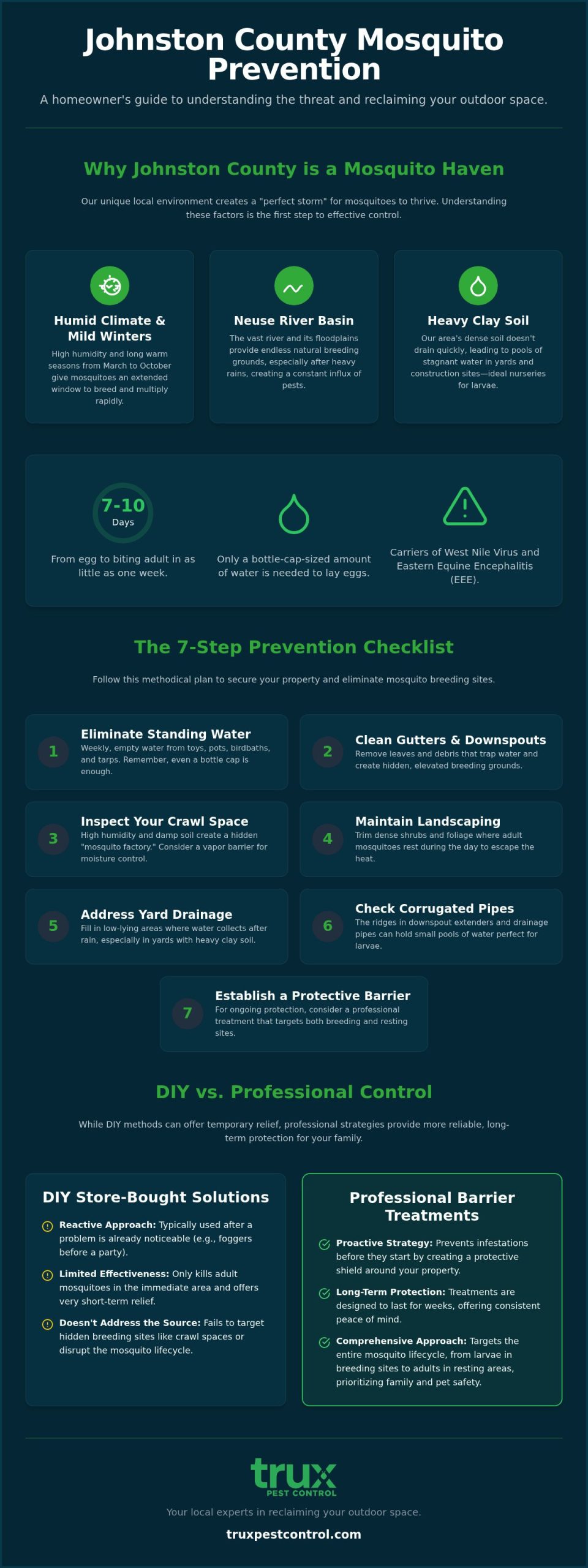
Maintaining a bite-free yard isn’t a one-time event. It requires a consistent, weekly routine that addresses the specific environmental challenges of our region. By following a structured timeline, you can proactively disrupt the pest lifecycle before it impacts your family’s comfort. This checklist serves as a methodical guide for mosquito prevention Johnston County homeowners can use to secure their property throughout the peak season. We recommend performing these steps every seven days to ensure no new generation has the chance to reach adulthood.
- Step 1: Weekly Tip and Toss. Walk your property to empty any container holding water. Don’t overlook hidden items like the folds in grill covers, discarded tarps, or the saucers under flower pots.
- Step 2: Clear Gutters. Ensure your gutters flow freely and are clear of organic debris. Clogged gutters create elevated breeding zones that are often the primary source of infestations near the roofline.
- Step 3: Manage Landscaping. Thin out dense English ivy and overgrown shrubs. Reducing this heavy foliage allows for better airflow and eliminates the cool, damp resting spots adults crave during the day.
- Step 4: Address Drainage Issues. Use soil or gravel to fill in low spots where water pools on our heavy clay soil. If water stands for more than 48 hours after a North Carolina rain shower, it’s a potential nursery.
- Step 5: Inspect the Crawl Space. Check for puddles or high humidity under your home. As we noted earlier, moisture here can sustain a population even when the rest of the yard feels dry.
Step 6: Maintain Your Pool and Water Features
Pools and ponds require specific, disciplined attention. Ensure your pool’s pump circulates water daily and maintain proper chlorine levels to prevent larvae from surviving. For ornamental ponds or birdbaths that don’t have filtration, use “mosquito dunks” containing Bti, a biological agent that targets larvae without harming birds or fish. If you use a pool cover, keep it pulled taut so that rainwater doesn’t collect in the sagging center.
Step 7: Schedule a Professional Inspection
Even the most diligent homeowner can miss subtle triggers. A professional eye can identify structural vulnerabilities or hidden breeding zones in dense pine straw that might go unnoticed. Scheduling an annual “Home Shield” evaluation before the peak summer heat ensures your defenses are ready. A professional assessment is a critical final step in comprehensive mosquito prevention Johnston County residents should consider for total peace of mind. We recommend a professional inspection to identify local vulnerabilities that manual checks might overlook.
Reclaiming Your Backyard with TruX Pest Control
TruX Pest Control operates as a disciplined guardian for your home and outdoor living spaces. With over 20 years of local experience across Johnston and Wake Counties, we’ve seen how regional shifts in weather and development impact local pest populations. We don’t just spray and leave; we provide a methodical shield designed to restore the comfort of your personal environment. Our team approaches mosquito prevention Johnston County as a collaborative effort, combining our technical expertise with your property-specific needs. This long-term stability is why our neighbors trust us to protect their families season after season.
We understand that a truly enjoyable yard is free from all biting pests, not just mosquitoes. Our protective strategy often integrates multiple outdoor services to create a comprehensive safety zone for your household. For instance, you might combine your seasonal barrier protection with a specialized fire ant treatment to ensure the ground is as safe as the air. Every application we perform adheres to eco-friendly, family-safe standards, ensuring your children and pets can play safely once the treatment has dried. We prioritize technical execution to ensure the highest standards of safety and effectiveness.
Customized Treatment Plans for Every Yard
No two properties in Johnston County are identical. A shaded lot in Smithfield faces different challenges than a new construction site in Clayton with unique drainage issues. We begin our process with a thorough assessment to identify your property’s specific triggers and breeding zones. From there, we build a tailored barrier protection plan that targets the precise areas where pests rest and reproduce. As a local, privately owned team, we know the neighborhoods we serve. We don’t offer one-size-fits-all solutions because we know that total protection requires detail-oriented, site-specific management.
Total Protection: Beyond Just Mosquitoes
Our methodical barrier treatments provide benefits that extend beyond just stopping the buzz. While we focus on mosquito mitigation, these applications also help significantly reduce populations of fleas and ticks that hide in your tall grass and perimeter shrubs. This multi-layered defense ensures your yard remains a sanctuary for relaxation rather than a source of worry. It’s time to reclaim your summer evenings and enjoy your Johnston County backyard again with the confidence that your home is fully shielded by a trusted local expert.
Protect your home and family today
Secure Your Sanctuary for the Season Ahead
Securing your home against seasonal surges requires a blend of local knowledge and methodical action. We have explored how Johnston County’s unique geography and humidity levels create a constant pressure that demands more than just reactive spraying. By implementing a consistent weekly checklist and addressing hidden moisture in areas like crawl spaces, you establish a strong foundation for a comfortable summer.
Professional intervention acts as the final, essential layer of your Home Shield. Our team brings 20 plus years of local experience to every property, utilizing eco-friendly and pet-safe treatment options that prioritize your family’s well-being. This comprehensive approach to mosquito prevention Johnston County homeowners deserve ensures that your yard remains a place of relief and restoration. We focus on long-term stability and thoroughness to ensure your outdoor spaces are protected throughout the entire season.
You don’t have to surrender your patio to the buzzing clouds this year. Take the first step toward a bite-free environment and start enjoying the outdoor lifestyle you love with total peace of mind.
Frequently Asked Questions
When is the best time to start mosquito prevention in Johnston County?
You should start your mitigation efforts in mid-spring, typically around March or April. In North Carolina, the mosquito season begins as soon as temperatures consistently stay above 50 degrees. Starting early allows us to establish a protective barrier before the first significant hatch of the season. This proactive timing is a core part of effective mosquito prevention Johnston County residents use to stay ahead of summer surges.
Are the mosquito treatments used by TruX safe for my pets and children?
Yes, our treatments are designed with the safety of your family and pets in mind. We utilize eco-friendly and low-toxicity options that provide powerful mitigation without compromising your home’s security. Once the application has completely dried, which usually takes about 30 to 45 minutes, it’s perfectly safe for children and pets to return to the yard and resume play. We prioritize these family-safe practices to ensure your peace of mind.
How often does a yard need to be treated for mosquitoes in North Carolina?
Most yards in North Carolina require professional treatment every 21 to 30 days during the peak season. This schedule ensures that the protective barrier remains strong even after heavy rain or high humidity. Regular applications are necessary because the products naturally break down over time. Maintaining this consistent rhythm is essential for long-term stability and the total protection of your outdoor environment throughout the humid summer months.
Can a vapor barrier in my crawl space actually help with mosquitoes?
A crawl space vapor barrier is a highly effective tool for reducing the moisture that attracts mosquitoes to your home’s foundation. Damp soil and high humidity under your house create a protected sanctuary where pests can thrive year-round. By sealing out this ground moisture, you eliminate a major hidden breeding site. This structural approach provides a deeper level of protection than standard surface treatments alone by addressing the root cause of the infestation.
What should I do if my neighbor has standing water but I don’t?
If a neighbor has standing water, your primary defense is maintaining a strong professional barrier on your own property. Mosquitoes are weak fliers and will often rest on treated foliage as they move toward your yard. While you can’t control their property, our barrier sprays act as a protective shield that stops pests when they cross your boundary. We also suggest a friendly conversation about local mosquito prevention Johnston County resources to help the whole neighborhood.
Do mosquito misting systems or barrier sprays kill bees and butterflies?
We take specific precautions to protect beneficial pollinators like bees and butterflies. Our technicians are trained to avoid treating flowering plants where these insects gather. We focus our applications on the underside of large-leafed plants and dense shrubs where mosquitoes specifically rest. This methodical, targeted approach ensures that we manage the pest population while preserving the health of your local ecosystem and protecting the pollinators that help your garden thrive.
What is the difference between mosquito control and mosquito prevention?
Mosquito control is often reactive, focusing on killing adult insects that are already present in your yard. Mosquito prevention is a proactive, environmental management strategy that targets breeding sites and larvae before they mature. Prevention involves structural changes like clearing gutters or installing vapor barriers to ensure pests never have a chance to multiply. We combine both methods to provide a comprehensive “Home Shield” that offers long-term relief and security.
How much does professional mosquito prevention cost in Clayton, NC?
The cost of professional service in Clayton depends on several factors, including your lot size and the density of your landscaping. Properties with heavy shade or significant standing water challenges may require a more intensive plan to ensure total protection. Because every yard is unique, we provide free inspections to give you an accurate quote. This ensures you receive a customized plan that fits your property’s specific needs and provides the best value for your home.
