

 Reviews
 Login
Login
In Raleigh’s vibrant and competitive dining scene, your restaurant’s reputation is its most valuable asset. Every detail, from the menu to the ambiance, is carefully curated to create an exceptional guest experience. Yet, a single, unwelcome pest can undermine it all in an instant. This is why proactive, professional pest management isn’t just a line item—it’s a foundational pillar of brand protection. Discover how a modern, eco-friendly strategy can safeguard your establishment’s health score, delight your patrons, and secure your reputation for years to come.
Protecting Your Reputation: The High Stakes of Restaurant Pest Control in Raleigh
For a restaurant owner in Raleigh, pest control is far more than a simple maintenance task; it’s an ongoing defense of your brand’s integrity. In a city celebrated for its culinary innovation, the standards for cleanliness and safety are exceptionally high. This requires a ‘Disciplined Guardian’ approach—a proactive, methodical strategy that anticipates and prevents pest issues before they can ever threaten your business.
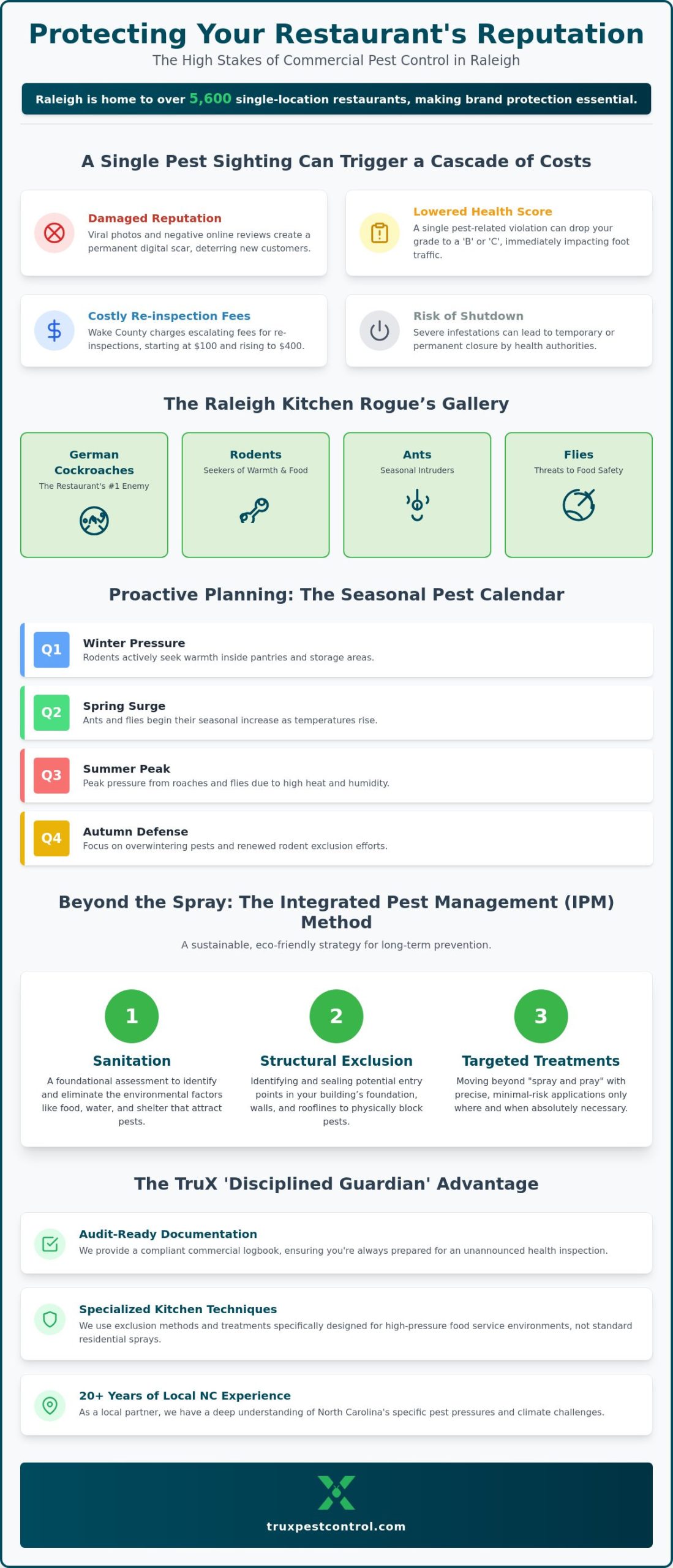
- The Wake County Health Score Link: In Wake County, health inspectors are trained to spot even subtle signs of pest activity. Evidence of pests, from droppings to live insects, can directly lead to a significant drop in your health score, a public marker of your restaurant’s quality.
- Understanding IPM: Commercial Integrated Pest Management (IPM) is the gold standard for food service environments. It is a comprehensive, science-based approach that prioritizes prevention, sanitation, and structural integrity, using targeted, low-impact treatments only when necessary.
- The Social Media Impact: In 2026, a single photo or negative review mentioning a pest can go viral, causing immediate and lasting damage to your revenue and public perception. Proactive pest management is your best defense against this digital-age risk.
The Cost of a ‘B’ Grade: Health Inspections in Wake County
A high health score is a badge of honor for any Raleigh restaurant, signaling to customers that you operate with the utmost care. Wake County Environmental Health inspectors have a stringent set of criteria, and pest evidence is a critical violation. A downgraded rating isn’t just a mark on a certificate; it’s a direct blow to your bottom line, deterring potential customers and raising red flags for regulars. The investment in a professional, preventative pest management program is consistently and significantly lower than the financial loss and reputational damage incurred from a single failed inspection and the subsequent emergency mitigation costs.
Online Reviews and the Digital Footprint of a Pest Problem
Before a potential diner ever steps foot in your restaurant, they are likely scrolling through Yelp, Google, and social media. Reviews mentioning cockroaches, rodents, or flies can haunt your online presence for years, creating a permanent digital stain. Effective restaurant pest management is a crucial component of maintaining ‘brand hygiene’ in the digital world. By partnering with a professional provider, you demonstrate a visible commitment to cleanliness and safety, building a foundation of trust with your clientele before they even walk through the door.
The Raleigh Kitchen Rogue’s Gallery: Common Pests We Combat
Commercial kitchens in Raleigh present a unique, high-pressure environment that attracts specific and resilient pests. The constant presence of food, moisture, warmth, and shelter creates an ideal breeding ground that renders traditional residential pest control methods ineffective. Understanding these primary threats is the first step toward building an impenetrable defense for your establishment.
- Primary Threats: The most significant challenges for Raleigh commercial kitchens are German cockroaches, rodents (rats and mice), and various species of flies, including drain flies and fruit flies.
- Seasonal Pest Calendar: Pest pressures in North Carolina shift with the seasons. From overwintering rodents seeking shelter in the colder months to summer swarms of flies and ants, a year-round strategy is essential for 2026.
- Specialized Eradication: At TruX, we have a specialized focus on the complex challenge of eliminating German cockroach populations, which are notoriously difficult to control in food service settings due to their rapid reproduction and ability to hide in tiny crevices.
German Cockroaches: The Restaurant’s #1 Enemy
No pest is more synonymous with kitchen infestations than the German cockroach. They thrive in the heat and moisture generated by dishwashers, ovens, and refrigeration units. These pests are often unknowingly brought into a pristine kitchen through supply shipments and cardboard boxes, making constant vigilance essential. With a reproductive cycle that allows a single female to be responsible for thousands of offspring in a year, a small problem can quickly escalate into a full-blown infestation, underscoring the absolute need for consistent, professional monitoring and intervention.
Rodent Exclusion: Keeping Rats and Mice Out of the Pantry
From historic downtown structures with aging foundations to new suburban constructions with unforeseen vulnerabilities, every Raleigh restaurant has potential entry points for rodents. Our ‘Shield’ approach focuses on structural exclusion—meticulously identifying and sealing every gap, crack, and utility penetration that a rat or mouse could use to gain entry. Effective rodent control goes far beyond setting traps; it involves a comprehensive assessment of the building’s exterior, waste management practices, and environmental conditions to eliminate the possibility of entry altogether.
Beyond the Spray: Why Integrated Pest Management (IPM) is Vital for Food Safety
The old approach of “broadcast spraying” chemicals throughout a kitchen is outdated, risky, and ineffective for long-term control. Modern, professional pest management for restaurants relies on the principles of Integrated Pest Management (IPM), a smarter, more sustainable philosophy. This detail-oriented approach reduces the reliance on chemicals and builds a true partnership between your pest control provider and your kitchen staff.
- Targeted Mitigation: IPM moves away from broad-spectrum spraying and toward a targeted strategy using baits, traps, and precise applications in areas inaccessible to food preparation surfaces.
- Reduced Contamination Risk: By minimizing chemical use, IPM significantly lowers the risk of cross-contamination, protecting the integrity of your ingredients and the safety of your staff and patrons.
- Sanitation as the Foundation: A successful IPM program is built on a foundation of rigorous sanitation. Pests require food, water, and shelter to survive. A professional partner helps your team identify and eliminate these sources, making your kitchen far less attractive to pests.
Eco-Friendly Protocols for Sensitive Environments
Forward-thinking Raleigh chefs and restaurant owners demand solutions that are as responsible as they are effective. Our commitment to eco-friendly protocols aligns with this modern standard. We utilize advanced tools like low-toxicity baits and insect growth regulators that target specific pests without impacting non-target species. The use of botanical-based products and pheromone traps allows for effective monitoring and control with minimal environmental impact. These non-toxic and low-impact methods are the preferred choice for maintaining a safe, clean, and healthy kitchen environment.
The Partnership Model: Staff Training and Sanitation
Preparing for Inspection: Documentation and Compliance Standards in Wake County
When a Wake County health inspector arrives, they will want to see more than just a clean kitchen—they will want to see a documented history of proactive pest management. A well-maintained and compliant logbook is your proof of due diligence and a key tool for ensuring a top health score. This documentation provides a transparent, action-oriented record of every service, finding, and corrective measure taken.
- Logbook Essentials: A compliant commercial pest control logbook must contain specific items, including Safety Data Sheets (SDS) for any products used, detailed service reports, pest activity logs, and technician certifications.
- Presenting to Inspectors: We ensure your documentation is organized, clear, and ready for review, allowing you to confidently present your pest management program to an inspector.
- Staying Current: Food safety standards can evolve. We stay informed about any 2026 regulatory changes in North Carolina to ensure your program remains fully compliant.
The Anatomy of a Compliant Logbook
Your pest management logbook is a critical compliance document. It should always be stored on-site and be readily accessible. Key components include an up-to-date site map showing the location of all monitoring devices, detailed reports after every visit outlining findings and actions taken, and all legally required documentation like SDS sheets. In today’s fast-paced environment, digital documentation is the gold standard for modern Raleigh restaurants, providing instant access and clear, audit-ready reports that TruX delivers after every single service.
Maintaining these digital records is part of a broader trend toward business modernization; for restaurants looking to further secure their operational technology, Carolina IT Group provides expert managed IT solutions throughout North Carolina.
Proactive vs. Reactive Compliance
True compliance is about more than just passing an inspection; it’s about preventing the conditions that lead to violations in the first place. By using trend analysis from our detailed reports, we can spot potential infestations before they become active problems. Think of your TruX technician as a ‘Disciplined Guardian’ for your facility—we are trained to flag structural issues, sanitation concerns, or operational habits that could attract pests, giving you the opportunity to correct them long before an inspector ever sees them. This proactive partnership is the key to maintaining consistently high standards. Learn more about our approach to Commercial Pest Control in Raleigh NC.
The TruX Advantage: Your Local Partner in Commercial Food Safety
Choosing a pest control provider is a decision that directly impacts your brand, your compliance, and your peace of mind. With over 20 years of local experience in North Carolina, TruX offers a level of regional expertise and personal commitment that large national chains simply cannot match. We are your neighbors, and we are invested in the success of your business.
- Local Expertise: Our deep understanding of Raleigh’s climate, construction styles, and specific pest pressures gives us a distinct advantage in designing effective, long-term solutions.
- Eco-Friendly Focus: Our commitment to family-safe, pet-safe, and eco-friendly protocols ensures our methods are appropriate for the most sensitive food service environments.
- Specialized Service: We maintain the highest standards by focusing exclusively on pest management. We do not offer wildlife trapping, allowing our team to be masters of their specific craft.
A Trusted Local Expert vs. National Chains
When you work with a locally owned business, you gain a partner who is directly accountable for your success. You know your technician, and you have a direct line of communication with a team that genuinely cares about protecting your restaurant’s reputation. This neighborly care translates into more thorough inspections and a more personalized service plan. We don’t see you as an account number; we see you as a vital part of the Raleigh community we serve.
Getting Started with TruX Pest Control
Protecting your restaurant begins with a comprehensive, no-obligation assessment. During our initial walkthrough, we will inspect your entire facility—from the receiving docks and storage areas to the kitchen and dining room—to identify potential risks and current vulnerabilities. From there, we will design a customized service schedule that fits your unique needs and operating hours, ensuring our work is always discreet and never disruptive. Take the first step toward total peace of mind. Protect your restaurant’s reputation with TruX today.
Frequently Asked Questions About Restaurant Pest Control
- Is pest control for restaurants required by law in Raleigh?
- Yes. The North Carolina Food Code requires that food establishments be maintained free of pests. A licensed pest control operator must be used if pests are present. Proactive, documented service is the best way to ensure compliance with Wake County health regulations.
- How often should a Raleigh restaurant receive professional pest control service?
- The ideal service frequency depends on factors like the age of the building, location, and pest pressure. However, most restaurants benefit from a monthly or bi-monthly service schedule to ensure consistent monitoring and prevention.
- Are the chemicals used in restaurant pest control safe for food prep areas?
- When applied by a licensed professional following Integrated Pest Management (IPM) principles, yes. We prioritize non-chemical solutions and use low-toxicity, food-safe products like baits and gels in sealed stations or deep within cracks and crevices, far from food preparation surfaces.
- What should I do if a guest spots a pest in my dining room?
- Address the guest’s concern immediately and professionally. Then, contact your pest control provider to schedule an urgent inspection. It’s also crucial to inspect the area for any sanitation issues that may have attracted the pest.
- Can pest control help improve my Raleigh health inspection score?
- Absolutely. A documented, professional pest management program is a key factor in achieving and maintaining a high health score. It demonstrates to inspectors that you are proactive about food safety and sanitation.
- How do I prepare my kitchen for a commercial pest control treatment?
- Your technician will provide specific instructions, but general preparations often include clearing counters, covering food prep surfaces, and providing clear access to areas like behind equipment and under sinks to ensure a thorough and effective service.
- Will professional pest control help with fruit flies and drain flies?
- Yes. A comprehensive service will address these common kitchen pests. Control often involves a combination of treating breeding sites (like drains and garbage areas) and advising staff on sanitation practices to eliminate the source of the infestation.
- What is the difference between residential and commercial pest control for food services?
- Commercial pest control for restaurants is far more complex. It requires an in-depth knowledge of food safety laws (like HACCP), extensive documentation for health inspections, and specialized strategies (IPM) to treat sensitive environments without contaminating food or disrupting operations.
